Government Support for Construction Workers
The Government of Jharkhand on June 06, 2025, Mandates Aadhar card for the Chikitsa Pratipurti Yojana, a scheme designed specifically for Construction Workers.
Administering Authority
This program is administered by the Building and Other Welfare Board and funded through the Cess Fund.
Financial Assistance for Critical Illness
Registered workers can receive financial assistance up to ₹2,50,000 for critical illness treatment under this scheme.
Legal and Notification Framework
The notification, issued under Section 7 of the (Targeted Delivery of Financial and Other Subsidies, Benefits and Services) Act, 2016, ensures identity verification and transparency.
Alternative Verification Mechanisms
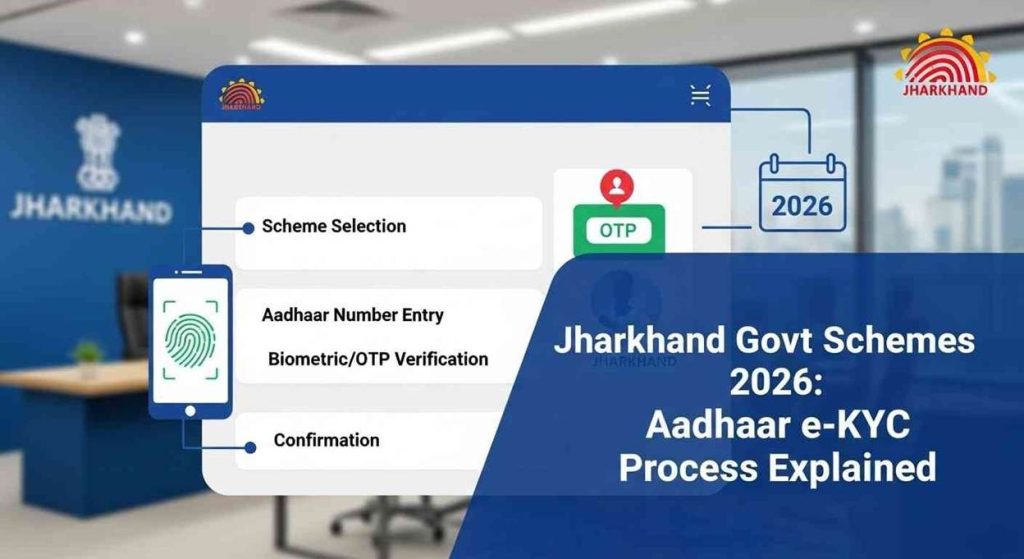
If authentication failure occurs, the scheme allows alternative mechanisms such as biometric modes, OTP, or offline Aadhaar verification using QR codes or e-KYC documents.
Eligibility and Beneficiaries
This scheme is only for beneficiaries aged 18 years and above. The Department will publicize the new requirement widely and handle exceptions according to Direct Benefit Transfer Mission guidelines. The program is officially notified in the Gazette.
Aadhaar Paperless Offline e-KYC Explained
The UIDAI has launched Aadhaar Paperless Offline e-KYC to help Aadhaar number holders voluntarily verify their identity in applications in a paperless and electronic manner. It maintains privacy, security, and inclusion, allowing agencies to use a simple mechanism for online authenticated verification. This method provides instant verification and lowers the cost of paper-based KYC.
Not all agencies can use online e-KYC due to technical infrastructure requirements. Sometimes devices or biometrics are necessary. UIDAI keeps a record of KYC requests for audit purposes.
Privacy, Security, and Control in e-KYC
Privacy is maintained as KYC data is shared only by the Aadhaar number holder. The reference ID is used instead of core biometrics like fingerprints or iris. Users can choose which demographics data or photo to share.
Security is ensured as Aadhaar KYC data is downloadable, digitally signed by UIDAI to validate authenticity and detect tampering. Agencies can use OTP or Face Authentication, and data is encrypted with a phrase that gives the Aadhaar number holder control over their information.
Inclusion is promoted since the e-KYC process is voluntary, user-driven, and works with consent. It allows wide usage across multiple agencies.
How to Use Aadhaar Paperless Offline e-KYC
The Aadhaar number holder can eliminate the need for a photocopy and directly download the KYC XML, which is machine-readable, digitally signed, and authenticated. The user can provide this data to agencies via multiple channels:
- Visit my Aadhar portal
- mAadhaar mobile application using registered mobile
- Inbound SMS via registered phone number
- Aadhaar Seva Kendra using Biometric Authentication
The e-KYC contains Name, Download Reference Number, Address, Photo, Gender, DoB, YoB, Mobile Number, Email. Data is encrypted using a Share Phrase.
Sharing and Formats of e-KYC
The Aadhaar Paperless Offline e-KYC data can be shared in Digital Format (XML, PDF) for high-quality photos or Printed Format (QR code) for physical submission. Low-resolution photos can be used for visual inspection.
Understanding technical facets helps Aadhaar number holders gain better clarity and confidence while submitting KYC documents. Using Aadar car download, my aadhar, UIDAI, and aadhar card ensures the entire verification process is smooth, secure, and widely accepted.